

Background and context
The Scout Movement is a non-formal education proposal oriented towards the comprehensive development of children, adolescents, and young people. Its educational approach is grounded in the purpose of the Movement, the Promise and Law, the Scout Method, learning by doing, the small group system, personal progression, life in nature, service, adult support, and the active participation of young people.
Social, technological, environmental, cultural, and generational changes require the Youth Programme to remain relevant, inclusive, safe, and meaningful. Innovation does not mean replacing Scout identity or chasing pedagogical or technological trends; it means renewing, with educational purpose, the experiences, methodologies, content, and institutional conditions that allow the Scout Movement's educational offer to stay relevant in changing contexts.
With this purpose, the World Scout Bureau (Interamerica Support Centre) invites National Scout Organizations (NSOs) to the Regional Workshop on Innovation in the Youth Programme.
Conceived as a practical space for initial decision-making within an innovation process, the workshop invites each participating NSO to identify a real challenge, select a priority innovation opportunity, and agree on next steps to develop it, test it, learn from it, and share results.
Objectives
The general aim of the workshop is to strengthen the shared understanding and initial capacity of NSOs to identify priority challenges in the Youth Programme, recognise criteria for educational innovation with Scout identity, and select cases that can move towards prototyping, piloting, and follow-up.
Specifically, the workshop will seek to:
- build a shared understanding of innovation in non-formal Scout education;
- distinguish educational innovation from novelty, programme updates, digitalisation, or cosmetic change;
- identify the fixed and variable elements of Scout education as a basis for innovating without diluting the identity of the Movement;
- analyse youth trends and the risks of not innovating, drawing on the realities, interests, and needs of young people;
- identify and prioritise, by NSO, a real Youth Programme challenge that can be worked on as an innovation opportunity; and
- agree on next steps for the subsequent design of prototypes, piloting, and regional follow-up.
Participants
The workshop is open to national teams from the NSOs that form the Interamerican Scout Region, with the capacity to influence the design, implementation, support, or evaluation of the Youth Programme. Each NSO is expected to form a delegation of four to six people, seeking balance between strategic, technical, operational, and youth perspectives.
Delegations are recommended to include, according to each NSO's structure, the following profiles:
- National Youth Programme coordinator, to lead the technical and programmatic analysis and ensure alignment with national priorities.
- Person responsible for Adults in Scouting, to identify the adult capacities needed to sustain innovation.
- Young person with real decision-making power, to contribute a youth perspective, validate relevance, and participate in prototype design.
- Operational leader with unit experience, to ensure practical feasibility and connection with the real life of Scout groups.
- Invited person with an external perspective, where relevant, to contribute a complementary view on education, innovation, community, inclusion, or evaluation.
Participants must have sufficient knowledge of the institutional foundations of the Scout Movement, the Scout Method, Youth Programme policies, the current situation of children and young people in their country, their NSO's national reality, and the main educational challenges facing their Scout groups.
We encourage NSOs to include young people with real influence in their delegations. Educational innovation must be designed together with young people: drawing on their voices, their tensions, and their ways of inhabiting the present.
Date and format
The Regional Workshop on Innovation in the Youth Programme will take place on Saturday, 18 July 2026, in virtual format, over a full day of synchronous work, with a preparatory phase beforehand and virtual follow-up afterwards.
Sessions will be facilitated through virtual platforms from 09:00 to 18:00 (Panama Time). To support collaborative work, each NSO's participants are asked to gather in the same physical space so they can discuss, reach agreements, and complete exercises as a team.
The workshop will include Spanish-English interpretation.
Workshop structure
The workshop is designed as a regional active-learning laboratory. Taking place in a single day, it will focus on building shared language, recognising innovation criteria with Scout identity, analysing youth trends, identifying priority challenges, and selecting one initial case per NSO for further development.
The pedagogical structure will be organised around four stages: understanding the purpose of innovating; reading trends and risks; focusing challenges with Scout identity; and agreeing on follow-up next steps.
The workshop will cover the following content and working tools:
- Innovation in Scout education: shared language, criteria, and distinctions from novelty, programme updates, digitalisation, or cosmetic change.
- Youth trends and the risks of not innovating: reading new youth realities and their relationship with the Youth Programme.
- Scout identity and innovation: distinguishing between fixed elements and those that can be renewed to improve relevance, access, educational quality, and impact.
- Inspiring innovation experiences: reviewing brief cases to extract transferable criteria.
- Rapid challenge mapping by NSO: identifying the most relevant entry point for innovation in each national context.
- Simple prioritisation: applying a quick filter to select an initial innovation case.
- Next steps: follow-up agreements, exchange, and further development of prototypes.
By the end of the workshop, each NSO will have: a shared definition of Scout educational innovation, an initial reading of trends and risks, an identity and innovation matrix, a formulated challenge, a prioritised case, and a minimum follow-up agenda.
At the regional level, the workshop will consolidate a first reading of shared challenges, common criteria to guide innovation in the Youth Programme, and a working foundation to support the subsequent development of prototypes by NSOs.
Agenda for Saturday, 18 July 2026:
Time | Session | Output |
09:00-09:30 | Opening and purpose of the workshop | Working agreement |
09:30-10:30 | Innovation in non-formal Scout education | Shared definition |
10:30-10:45 | Break | — |
10:45-12:00 | Youth trends and the risks of not innovating | List of priority challenges |
12:00-13:00 | Innovating with identity: the fixed and the variable | Identity and innovation matrix |
13:00-14:30 | Lunch | — |
14:30-15:45 | Inspiring innovation experiences | Transferable criteria |
15:45-16:00 | Rapid challenge mapping by NSO | Formulated challenge |
16:00-17:00 | Break | — |
17:00-17:45 | Simple prioritisation | Prioritised case |
17:45-18:00 | Next steps | Follow-up agenda |
Cost and registration
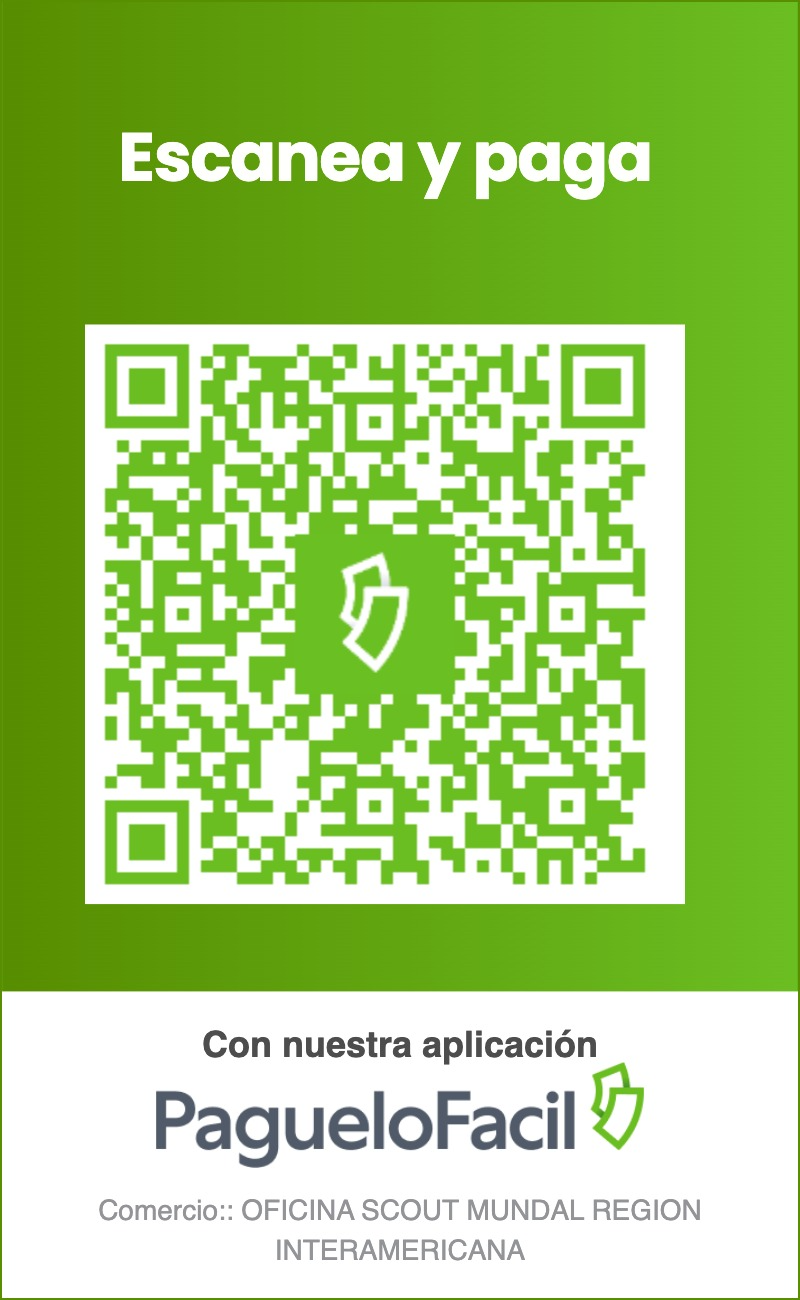
The participation fee is USD 20 per NSO, payable by credit card using the QR code included in this communication. When making the payment, please include in the description: Innovation Workshop, [country name].
Information must be submitted per NSO and include:
- name of the NSO;
- name, role, email address, and working language of each participant;
- name and email address of the NSO's liaison person for coordination purposes;
- confirmation of the physical space where the NSO team will gather, when available; and
- official certification from the NSO confirming that participants have been formally designated to attend the workshop.
Each participant must also attach a valid Safe from Harm certificate in accordance with regional participation requirements. Those who need to complete the course can access it online. Those who have completed it since 1 July 2024 do not need to repeat it, but must attach the corresponding certificate.
Once registration is confirmed, connection details, technical guidance, working materials, and a preparatory brief will be sent to all participants.
For any questions or clarifications about this call, please contact Mauricio Veayra at [email protected].
Yours in Scouting,
Diana Carrillo
Regional Director
World Scout Bureau
Interamerica Support Centre