


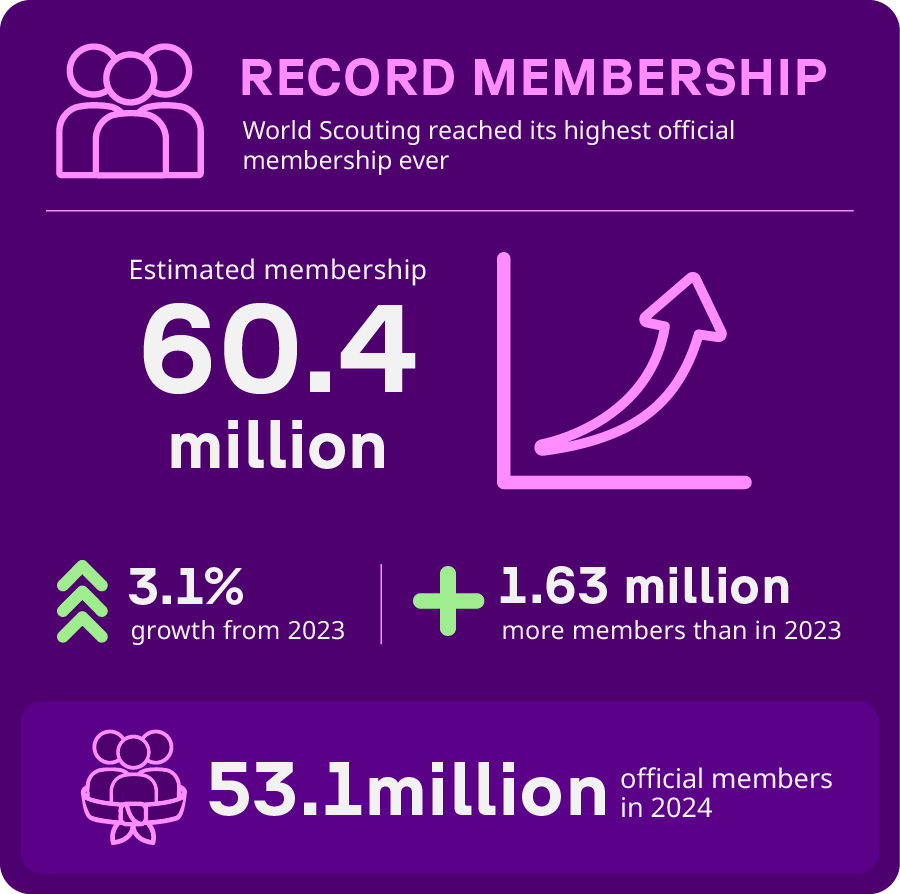
The most recent official census counted 53.1 million members, while the latest estimate places the Movement’s membership at 60.4 million. Beyond its regular members, Scouting reached another 10.9 million people through educational, humanitarian and social activities.
Summary of membership trends
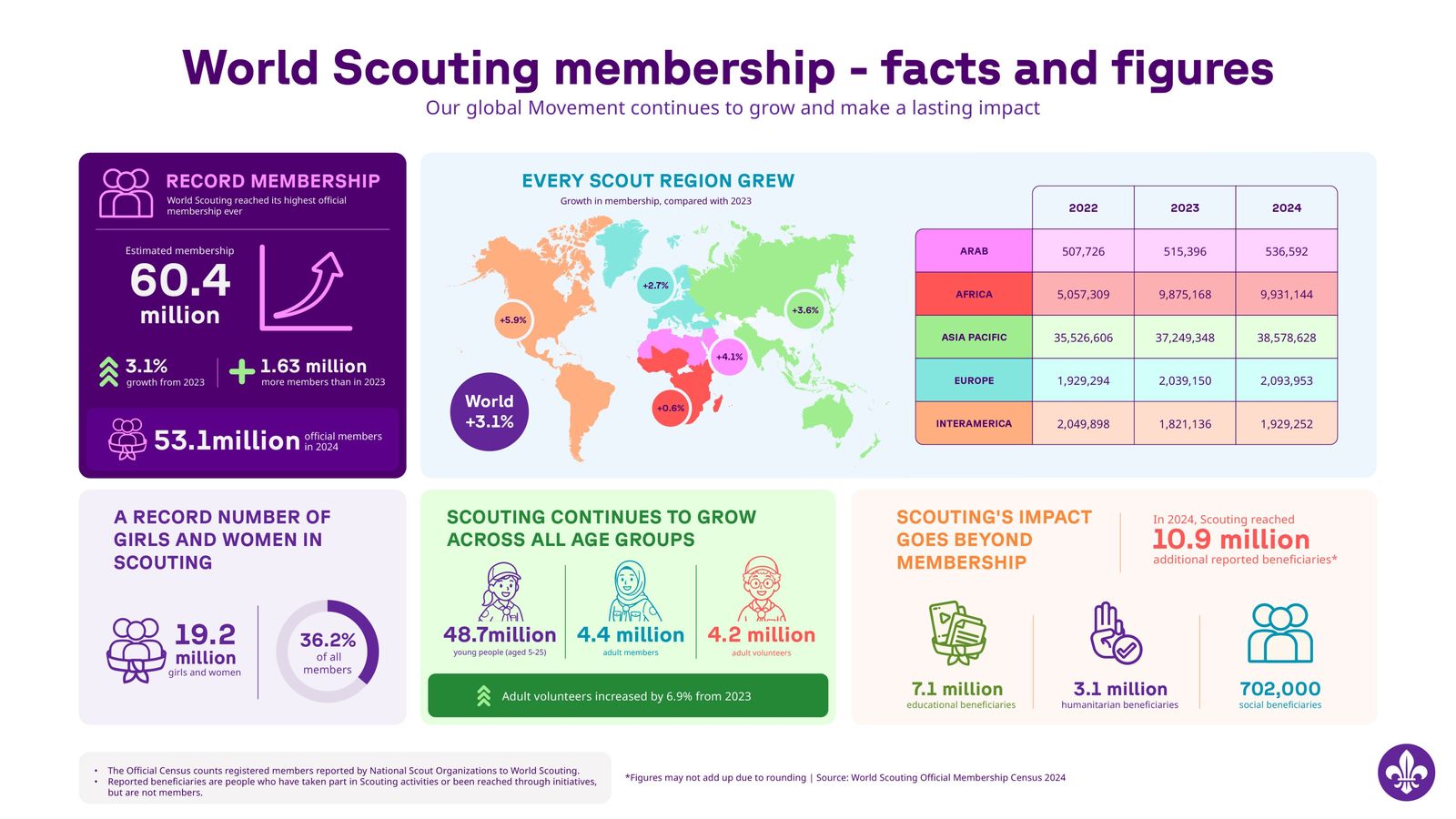
World Scouting recorded the largest official membership total in its latest census, extending a period of growth that began after the pandemic. The official census counted 53.1 million members, an increase of 3.1%, or approximately 1.63 million people, from the previous year.
The latest estimated census places World Scouting’s membership at 60.4 million.
The two totals measure different things. The official census records members formally reported to World Scouting, while the estimated census offers a broader assessment of the Movement’s likely size based on reports provided by the Regional support centres. Together, they show both the scale of Scouting and the work still required to produce a complete picture of its membership.
Growth reached every Scout region
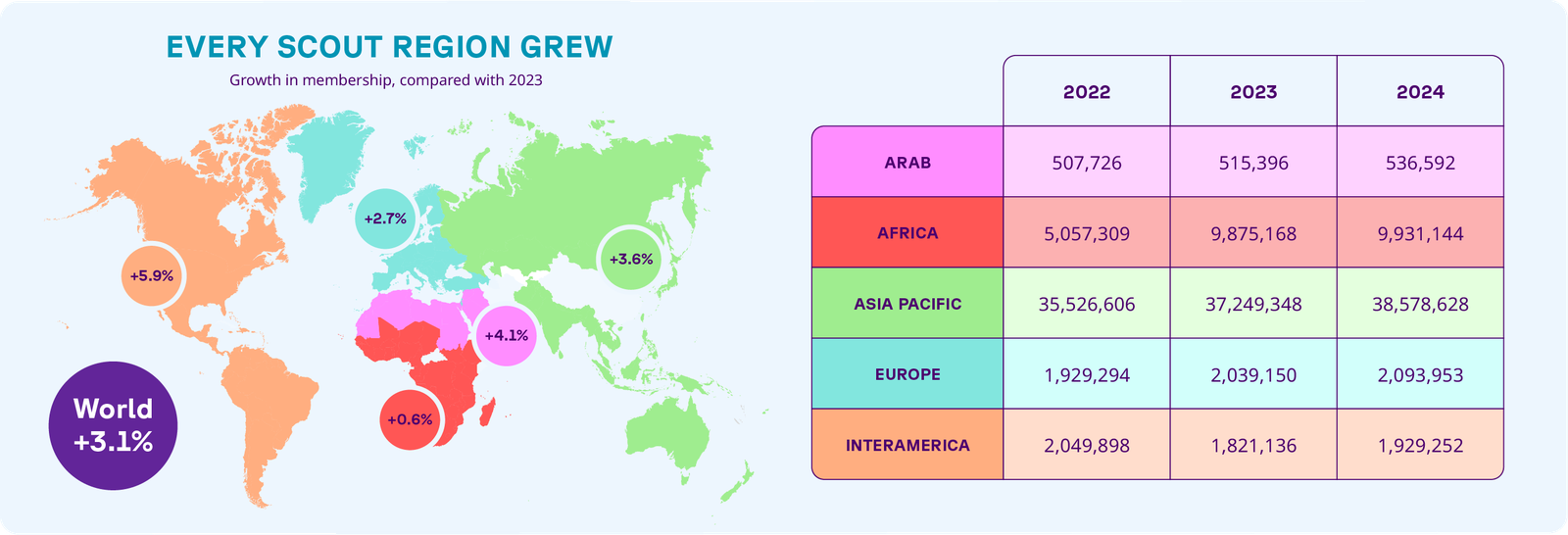
During the reporting cycle, every Scout region recorded membership growth. But the pace of growth varied considerably.
The Interamerican Scout Region grew by 5.9%, the fastest increase among the five regions. Its membership rose from 1.82 million to 1.93 million. That marks a strong recovery, although the region’s membership remains below the 2.05 million reported two years before.
The Asia-Pacific Scout Region grew by 4.8% and remains, by a wide margin, World Scouting’s largest region, with approximately 38.6 million members. Its scale means that even a modest percentage change can add a substantial number of Scouts to the global total.
The Arab Scout Region grew by 4.1%, reaching 536,592 members. Europe recorded growth of 2.7%, while Africa increased by 0.6%.
Africa’s slower growth follows an exceptional increase in the previous year, when its official membership nearly doubled. Its membership now stands at approximately 9.9 million. This suggests a period of consolidation after large numbers of existing members were brought into official registration.
The regional figures show that growth is broad, but its causes differ. In some places, more people are joining. In others, stronger registration systems are making existing participation visible for the first time.
More girls and women than ever
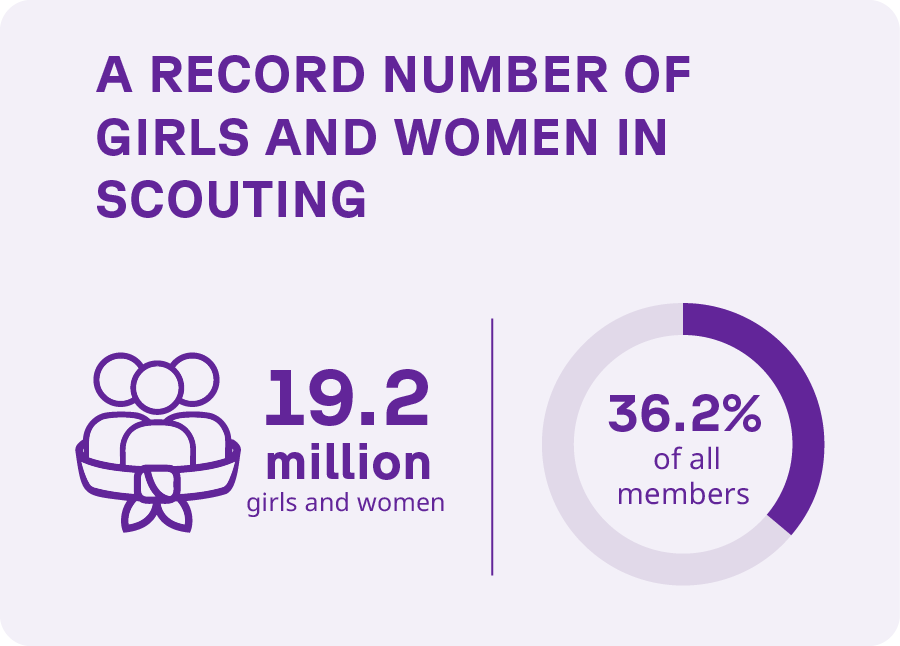
NSOs have reported 19.2 million girls and women, the highest number recorded in the Movement’s history.
The record is an important measure of scale. Girls and women now represent 36.2% of official membership, meaning that more than one in three registered members is female.
The two figures also tell slightly different stories. The number of girls and women continues to rise, but their share of total membership has not increased at the same pace. Overall membership is growing faster, leaving female representation broadly stable and slightly below its level in the years immediately following the pandemic.
The challenge is therefore no longer simply to increase the number of girls and women in Scouting. It is to ensure that their participation keeps pace as the Movement expands.
Young people remain the centre of the Movement
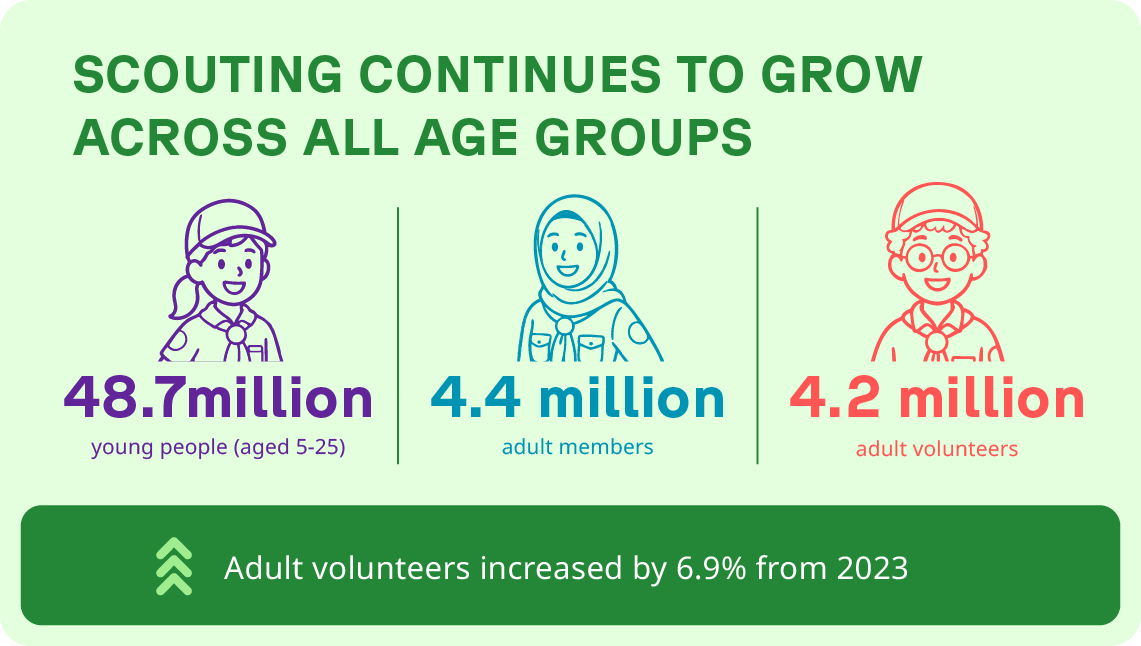
Young people account for most of World Scouting’s membership. The 2024 census recorded 48.7 million youth members, compared with 4.4 million adult members.
This works out to roughly 11 young people for every adult member worldwide. The ratio varies across regions and does not directly measure the availability of Scout leaders, since countries classify adult and youth programme participants differently. Still, it offers a useful indication of the adult capacity available to support a growing youth membership.
World Scouting recorded 4.2 million adult volunteers, an increase of 6.9% from 2023. Adult volunteers therefore grew more than twice as fast as overall membership.
That matters because membership growth depends on more than recruitment. New youth members require trained adults, functioning local groups and safe, well-supported programmes. Sustaining growth will increasingly depend on whether the Movement can continue expanding its volunteer base alongside its youth membership.
Scouting’s reach extends beyond registered membership
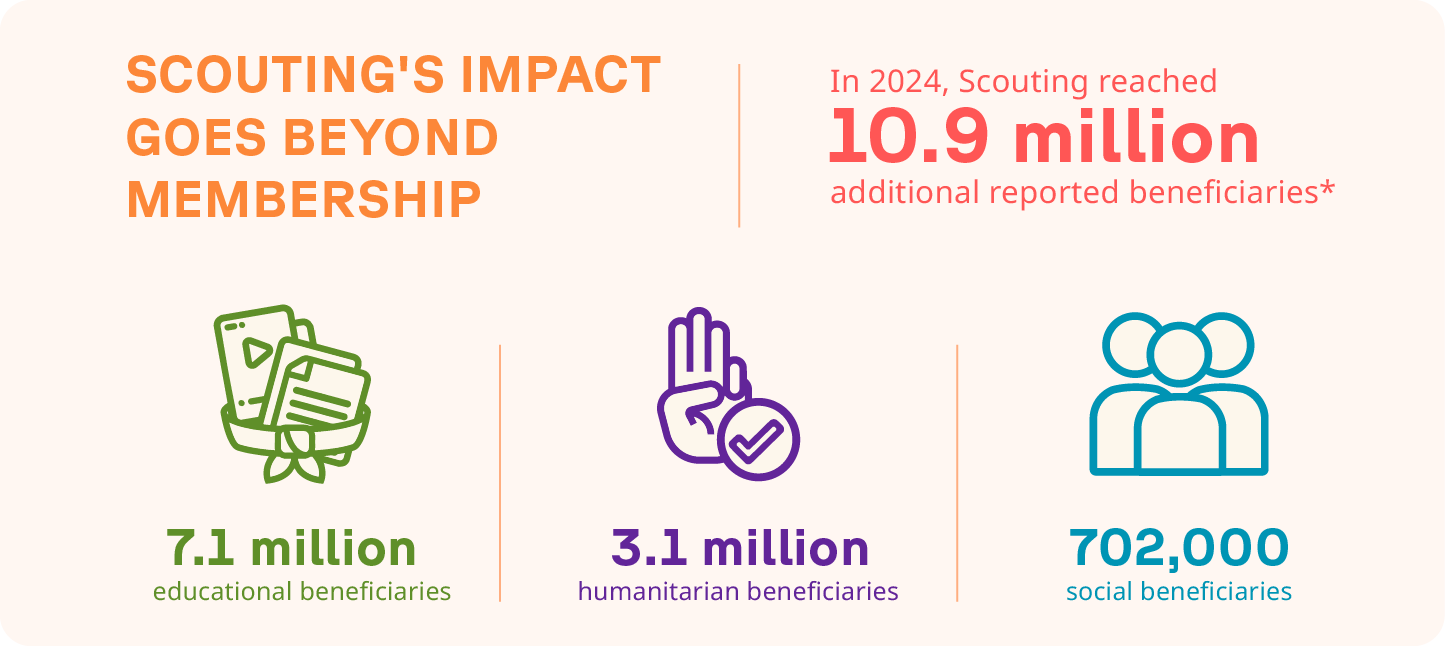
Membership figures capture only part of Scouting’s reach. National Scout Organizations reported 10.9 million additional beneficiaries: people who participated in or benefited from Scouting activities without being registered as members.
Educational activities accounted for the largest share, reaching 7.1 million people. These beneficiaries include community members and members of the public who participated in educational programmes, activities and events.
Another 3.1 million people were reached through humanitarian activities, including refugees, displaced people and migrant communities. Social initiatives reached approximately 702,000 people, including people living with disabilities, chronic health conditions or poverty, as well as minorities, orphans, street children and people in detention.
These beneficiaries should be reported separately from membership. They are not registered Scouts and should not be added to the official or estimated membership totals. Their inclusion nevertheless provides a fuller picture of Scouting’s public impact.
For every five registered members counted in the official census, Scouting reached roughly one additional person through these wider activities.
A growing Movement and a clearer view of its reach
The latest figures show a Movement growing across every region. Official membership reached a record 53.1 million, with new highs in participation by girls and women and particularly strong growth among adult volunteers.
They also provide a clearer picture of Scouting’s wider reach. Alongside officially reported membership, the estimated census puts total membership at 60.4 million when under-reporting is taken into account, while a further 10.9 million people are reached through Scouting’s educational, humanitarian and social activities. Together, these measures show both the scale of the Movement and the breadth of its impact.
Barriers to membership registration
The key factor for the difference between the latest estimated census and the official census is underreporting. In these cases, governance challenges remain a key barrier for some NSOs to fully track and report their membership and capitalise on growth opportunities.
Some NSOs are struggling with membership data accuracy, particularly in reporting from the grassroots level. In certain cases, NSOs have opened new units but have yet to register them due to administrative or leadership constraints. Others are still in the process of integrating their members into digital membership systems.
Additional challenges include inaccurate census data, leadership disputes, governance issues, and management inefficiencies that hinder proper tracking and planning.
Conflict-affected regions experience operational disruptions, making data collection difficult. Some NSOs are making progress in inclusivity by reporting female membership for the first time, but others still face challenges in ensuring full representation. Addressing these issues requires continued investment in strategic planning, data accuracy, and capacity strengthening.
World Scouting Official membership data
World Scouting maintains official membership records of all of its Member Organizations and additional data gathered by the World Scout Bureau. Overall, World Scouting’s membership census data reveals a thriving and diverse global movement united in its commitment to contributing to the education of young people and creating a better world.
The official membership census of World Scouting is based on data provided by NSOs and covers both youth members and adult volunteers. The census includes information on total membership, male, female, and other membership breakdowns, and age ranges for its programme sections. The collected data is used to track changes in membership over time, identify areas of growth or decline, and help World Scouting plan for the future. The World Scouting membership census is an essential tool for understanding the impact of Scouting worldwide and for ensuring that resources are allocated effectively to support Scouting programmes and activities.
Detailed information and additional support regarding NSO Annual Reporting to World Scouting can be found at the following link.
The World Scout Bureau is dedicated to providing the latest and most accurate data available. This page will be updated as we receive and analyse new membership data. Make sure you visit this page to be up to date with the latest membership data in World Scouting.