


The 2026 World Scouting Annual Survey shows a Movement building momentum, with National Scout Organizations (NSOs) taking practical steps to strengthen programmes, widen participation and develop more resilient organisations. NSOs are updating their Youth Programmes, widening participation and looking for new sources of income. At the same time, 69% say they do not have enough adult volunteers, young people remain underrepresented in national governance, and digital use is still concentrated in basic tools.
The survey was completed by 110 of 176 NSOs across all five World Scouting regions, a response rate of 62.5%. It provides a snapshot of how NSOs are advancing priorities related to Youth Programme innovation, diversity and inclusion, volunteering, organisational resilience, governance, digital capacity and external engagement.
What the survey says
The direction is clear. NSOs want more relevant programmes, more inclusive organisations, stronger volunteer systems and more sustainable funding. In several areas, however, commitments are outpacing implementation.
World Initiatives are helping NSOs keep their Youth Programmes relevant, but many NSOs still lack the people, resources and data needed to turn policy into consistent practice. The same gap is visible in digital development: communication tools are widespread, while systems for member management, analytics and decision-making are much less common.
The most urgent questions are about power and capacity. Nearly seven in ten NSOs report too few adult volunteers, and only 18% say people under 30 hold at least 40% of voting seats on their national board. Put simply, Scouting's challenge is no longer only to set the right priorities. It is to build the systems, leadership and resources required to deliver them.
World Initiatives are improving Youth Programme relevance
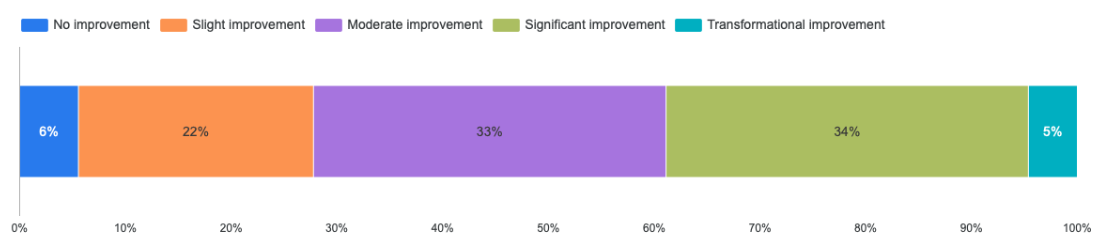
72% report that World Initiatives have improved the relevance of their Youth Programme at least moderately.
Most responding NSOs see a clear benefit from World Initiatives. Just over one third reported a significant improvement in the relevance of their Youth Programme, while 5% described the change as transformational.
NSOs are also making substantial changes of their own during the 2024–2027 triennium. Around seven in ten are improving how their Youth Programme is delivered or revising the programme itself, while 60% are incorporating new technologies.
The findings suggest that relevance depends on more than strong educational content. NSOs also need practical support to adapt global initiatives to national contexts and improve how programmes reach young people.
Inclusion is widely embedded, but delivery remains uneven
85% include diversity and inclusion elements in their Youth Programme
Diversity and Inclusion are increasingly part of the core work of NSOs. They feature Diversity and Inclusion not only in Youth Programmes, but also in governance and growth planning. Yet only 52% reported allocating resources to this work, suggesting that organisational commitments are not always matched by funding, staff time or delivery capacity.
The evidence base is also incomplete. Twenty-nine NSOs said they could not estimate the share of members from underserved socio-demographic groups. Without that information, it is difficult to know which communities are being reached and where participation gaps remain.
Many NSOs are already taking practical action. Community outreach was reported by 68% of respondents, while 65% run inclusive camps and activities. The next step is to connect these efforts with clearer evidence and dependable resources, so that inclusion becomes measurable practice rather than policy alone.

Adult volunteer capacity remains under pressure
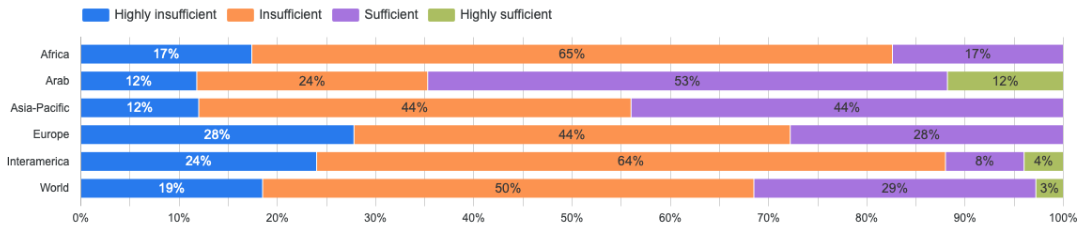
69% report an insufficient number of adult volunteers to support Scouting.
Adult volunteers remain one of the clearest constraints on the capacity of NSOs. Half of respondents described volunteer numbers as insufficient and a further 19% as highly insufficient. Only 32% considered their numbers sufficient or highly sufficient.
NSOs are responding by redesigning how volunteering works. Ninety-one per cent plan to create or revise their Adults in Scouting management system or policy, with greater flexibility a central priority. Flexible training options, including online, asynchronous and modular formats, are already used by 72% of respondents.
How sufficient are the number of adult volunteers in your NSO/NSA to support Scouting in your country?
This is more than a recruitment issue. Sustained growth will depend on whether NSOs can offer realistic routes into volunteering, support adults throughout their journey and give young adults meaningful opportunities to lead.
NSOs are actively diversifying their income
91% plan to adopt new sources of income during the 2024–2027 Triennium
Membership fees remain the most common source of income, reported by 81% of respondents. Government support and income from Scout shops or merchandise are also widely relied on.
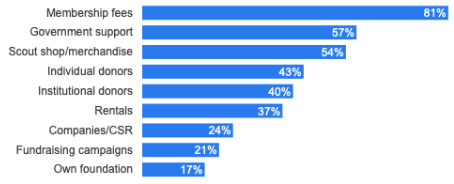
The strong intention to develop new income streams (91%) points to a wider concern about financial resilience. A broader funding mix can reduce dependence on any one source and give NSOs more room to invest in programme quality, volunteer support, inclusion and growth.
The opportunity is significant and it will require stronger fundraising skills, purposeful partnerships and sustainable models suited to national contexts.
Young people remain underrepresented in national governance
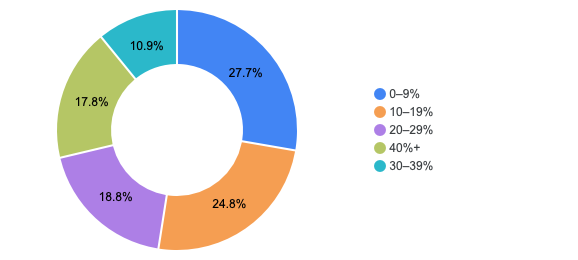
Only 18% report that people under 30 hold at least 40% of voting seats on their national board
Youth representation with voting rights remains limited in many NSOs. More than half of respondents reported that people under 30 hold fewer than one in five voting seats on their national board.
When asked where support is most needed, NSOs placed the greatest emphasis on building young people's confidence and skills to take on leadership roles, followed by increasing youth representation in governance bodies.
The gap is not solved by inviting young people into the room. It requires clear pathways into leadership, preparation and mentoring, and governance cultures in which young people can exercise genuine influence over decisions.
Digital use is widespread, but deeper capacity remains limited
91% use communication and collaboration platforms, but fewer than half use member management or CRM systems
Digital adoption is broad, but it is concentrated in basic tools. Communication and collaboration platforms are almost universal among respondents. By comparison, 48% use member management or customer relationship management systems, and 29% use data and analytics platforms.
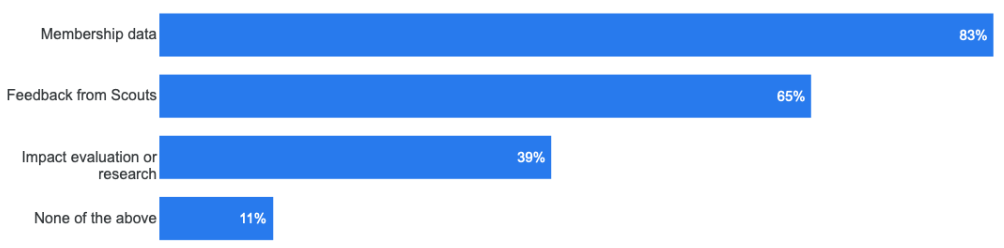
The same pattern appears in the information used for planning. Membership data are used by 83% of respondents, while only 39% use impact evaluation or research. NSOs are therefore much better equipped to count participation than to understand programme quality and results.
The next stage of digital development is not simply to add more platforms. It is to build connected systems and the skills to use them, helping NSOs turn information into better decisions.
Communication plans are creating pathways to external influence
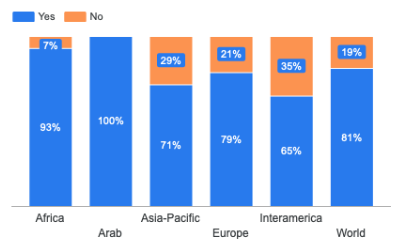
69.2% of NSOs report having a communication plan
Many NSOs are preparing to engage audiences beyond Scouting. Among those reporting on the content of their communication plans, 81% include objectives and activities aimed at the public, governments or civil society organisations.
External representation is also well established. Across 93 valid responses, Scouts represented their NSOs at 571 forums or consultation events during the previous 12 months, with a median of four events per organisation.
Participation alone, however, does not guarantee influence. Communication plans can help NSOs decide which audiences and issues matter most, prepare young people and adults to represent the Movement, and follow up so that external engagement contributes to policy or practice.
The 2026 World Scouting Annual Survey shows NSOs making progress in strengthening programmes, widening participation and building more resilient organisations. Across the Movement, NSOs are exploring new ways to support volunteers, strengthen youth leadership, use digital tools and diversify income. The findings reflect both the momentum already underway and the different paths organisations are taking to create lasting impact in their national contexts.
Source: World Scouting Annual Survey 2026. Percentages are rounded, and the number of responses varies by question.