


Summary of membership trends
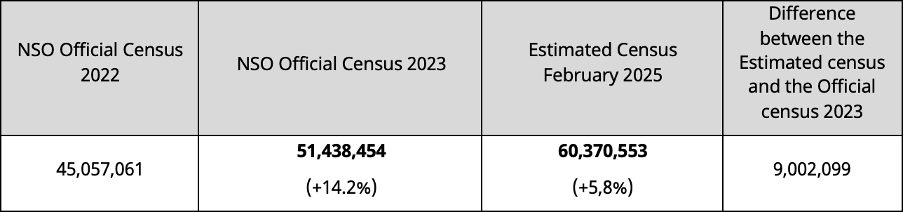
Official data for 2023 suggests a significant increase in reported World Scouting membership. The official census indicates that World Scouting membership increased by 14.2%, reaching a total of 51,438,454 registered members. This represents the highest annual growth since 2010 and continues the positive trend of 5% growth in 2022 and 0.3% in 2021. The membership reported in the 2023 official census is the highest ever reported to World Scouting.
To complement the official census and help improve the accurate assessment of World Scouting's membership, the Regional Support Centres conducted a comprehensive estimated census in January and February 2025. This includes members who have not been officially reported due to logistical reasons or political difficulties. With these figures, the total estimated census reports a membership of 60,370,553 members, a 5.8% increase (+3,330,243 members) compared to the 2024 estimated census.
Key insights
World Scouting's official membership is the highest to date
The 2023 official census data suggest that World Scouting saw a membership increase of 14.2%, or approximately 6.3 million more members (+6,381,393) compared to the 2022 official census. The data from the 2023 census sets World Scouting's reported membership at 51,438,454 members.
Similar to the census in 2021 and 2022, a high percentage of NSOs (37%) haven’t submitted a new census or have reported the same membership numbers.
The estimated census and insights from interactions with NSOs suggest that, in many cases, these NSOs lack the capacity to run effective membership management systems and provide annual updates. This limitation to obtaining timely membership data is addressed with the estimated census, through which the Regional Support Centres obtain more accurate and timely membership records that better reflect the reality on the ground. This estimated census reports a membership of 60,370,553 members, a 5.8% increase (+3,330,243 members) compared to the 2024 estimated census.
Regional overview
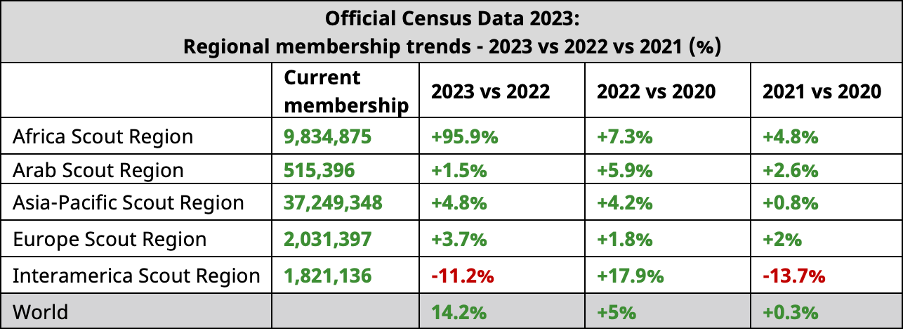
Four out of the five World Scouting regions recorded growth in 2023. The membership in the African region increased by 95.9%, almost doubling its official membership. The Asia-Pacific region grew by 4.8%, followed by the European region (3.7%) and the Arab region (1.5%).
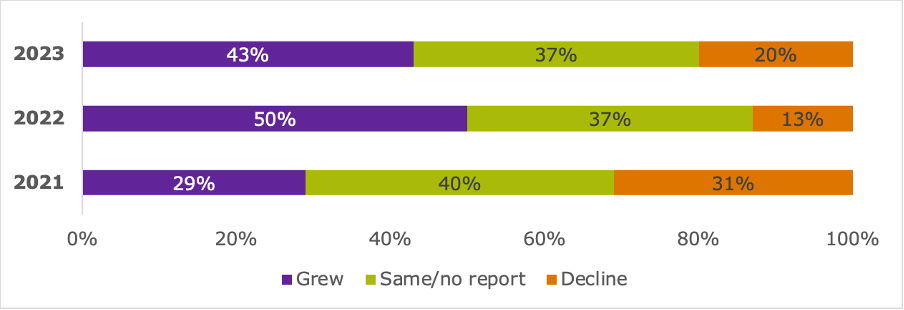
The data indicates that among the 111 NSOs that reported their membership in the 2023 Official Census, 68.5% (76 NSOs) saw an increase in membership. However, these levels are lower compared to 2022, when 80% of the NSOs that submitted the census (N=109) increased their membership. Out of all NSOs, 43% increased their membership, 20% decreased, and 37% did not report or reported the same numbers.
According to the official census, five NSOs account for most of the absolute growth worldwide. The largest contributors to the worldwide membership increase are the Scout Association of Nigeria, which registered 2,265,806 new members, and the Kenya Scout Association, which registered 2,155,404 new members.
Other significant contributors include the Boy Scouts of the Philippines (+772,053), the Bharat Scouts and Guides (India) (+672,796 members), and the Tanzania Scouts Association (+279,030 members). Significant contributors from other regions include Türkiye İzcilik Federasyonu (Türkiye) (+48,092), Asociación de Guías y Scouts de Chile (+7,514), and Boy Scouts and Girl Guides of Libya (+ 3,905 members).
In terms of relative membership growth, the biggest increase is recorded in the Scout Association of Nigeria (302%), the Scout Association of Saint Vincent and the Grenadines (146%), and Nepal Scouts (145%). The biggest relative decline in membership is recorded in the Scout Association of Belize (-39.6%), Scouts South Africa (-30.8%), and Association Nationale des Scouts D'Haïti (-28.9%).
It is important to note that in some cases, significant adjustments in membership resulted from updated membership records and registration rather than changes in membership on the ground. For example, in addition to the strong focus on organic membership growth, the significant membership increase in the Africa region is a result of the extended efforts of the NSOs to officially register existing members.
The estimated census compensates for these and other cases where time gaps and data quality discrepancies exist by providing additional insights and NSO context that will help the regions devise growth and support strategies toward these NSOs.
Number of girls in Scouting reaches new record
The 2023 official census shows the highest number of female members registered in World Scouting membership to date, surpassing the record number of registered girls in 2022. The current female membership in World Scouting is 18,796,747, an 11% increase compared to 2022 (16,987,346), and a 42% increase compared to 2014 at the start of Vision 2023.
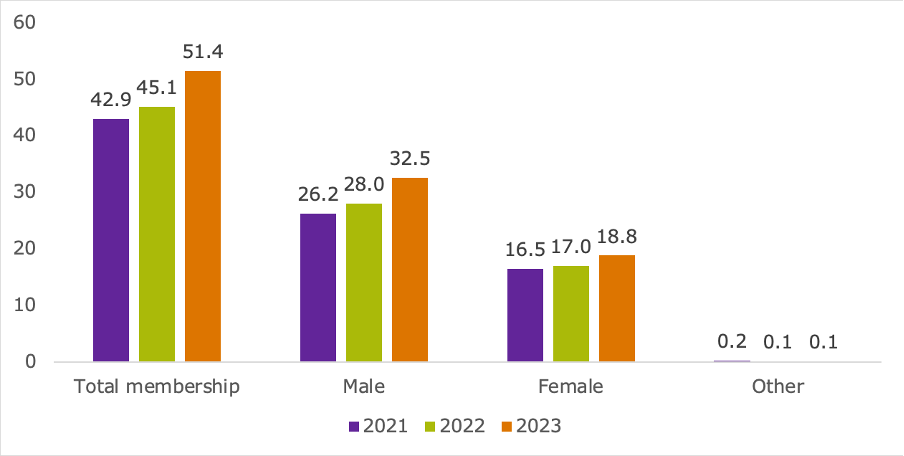
Despite the increase in the absolute number of girls registered, their proportion of World Scouting's total membership decreased to 36.5% from 37.7% in 2022 and 38.3% in 2021. The long-term trend is still positive, with the percentage of registered girls reaching 36% at the start of Vision 2023 in 2014.
At the regional level, the highest proportion of female membership is in the African region, with 40.5% of the total membership. In terms of absolute numbers, most girls are registered in the Asia-Pacific region (13,542,843).
Youth membership is growing faster than adult membership
Adult membership in 2023 grew by 6.5% compared to 2022. However, the overall trend shows that adult recruitment is not keeping pace with youth growth.
Over the past three years, adult membership increased from 3,622,354 to 4,239,463 (a 16.7% increase), while youth membership grew from 39,284,670 to 47,198,989 (a 20.1% increase). As a result, the youth-to-adult ratio fluctuated, decreasing in 2022 before rising again in 2023.
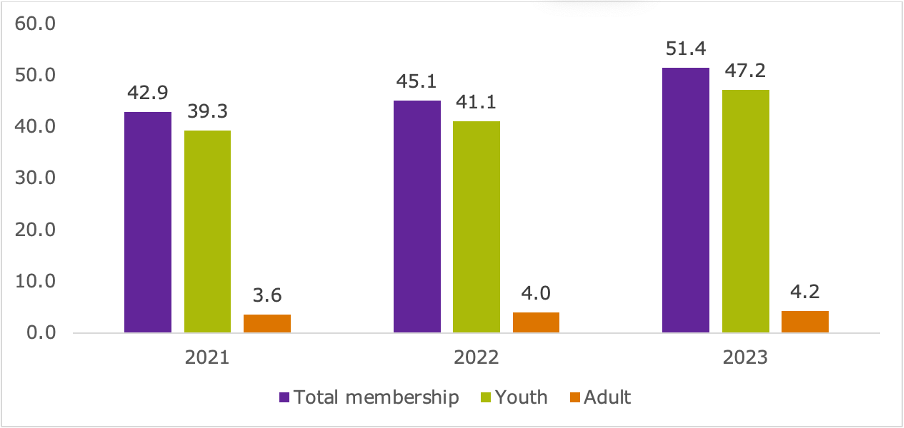
This widening gap could indicate a challenge in attracting and retaining sufficient numbers of adult leaders, which could affect the sustainability of membership growth. The gap is most pronounced in the Africa region, where there are approximately 19 youth members for every one adult member, followed by the Asia-Pacific region with 14 members for every one adult member, followed by the Arab region with ten youth for every one adult, and the European and Interamerican regions with approximately two youth members for every one adult member.
Understanding the adult-to-youth ratio in the NSOs is essential for assessing how well-supported young people are in the Scouting movement and how supported adults feel within the Adults in Scouting cycle. A balanced ratio ensures that youth receive the attention, guidance, and safe environment they need to fully benefit from the Youth Programme. It is important to note that some NSOs classify those over the age of 18 as adults, even if they are still involved in youth programmes, such as Rovers. The data provides a limited overview of the distinction between adults who work directly with young people and those who serve in supportive roles. Examining individual cases could help offer a clearer picture and foster better connections between young people and adult leaders.
NSOs reported over 2 million beneficiaries
In addition to the reported World Scouting membership, NSOs reported 2,050,665 beneficiaries, which are young people or adults who are not reported as members but benefit from or join Scouting activities.
Out of these, 1,313,799 are humanitarian beneficiaries, such as refugees, displaced or migrant youth and/or adults. NSOs have also reported 560,678 as educational beneficiaries, such as community members or the public who benefited from educational activities, such as those joining Scouting activities or events (in-person or online). Finally, NSOs reported 176,188 social beneficiaries (people affected by chronic health conditions, living with disabilities, poverty, minorities, orphans, street children, or those living in detention centres).
The number of beneficiaries reported for the 2023 Official census is lower (-77%) compared to the 2022 official census, when the NSOs reported 3,631,896 beneficiaries. During the 2023 official census, 36 NSOs/NSAs reported beneficiaries in at least one of the beneficiary categories, which is lower compared to the official census 2022, when 55 NSOs/NSAs reported at least one category of Beneficiary.
Additional information and support to report beneficiaries are available at this link.
2025 estimated census
Official census data does not always reflect the number of Scouts involved in the Movement. The estimated census is one of the tools used since 2017 to identify gaps and gather insights into World Scouting's membership. This effort is implemented through Regional Support Centres and requires outreach to NSOs to review officially declared numbers and understand challenges faced by the NSO in measuring and declaring its full membership. These challenges are typically categorised into three groups:
- Membership data quality and time gap - meaning changes in the membership that occurred after the submission of the latest census of the NSO, or misunderstanding of WOSM’s census format;
- Institutional restrictions - meaning that the NSO is not in a position to declare its full membership due to organisational policy;
- Underreporting - meaning that the NSO is not able to fully capture its true membership due to a lack of internal reporting, political complexity, financial reasons, and membership management system issues.
Starting from 2024, additional efforts were put in place to enhance the reliability and consistency of the estimated census. The improved methodology focused on a more unified approach across the regions and added additional provisions regarding the NSO context, sourcing of information, and determination of confidence level for each estimated census entry. The information was obtained through bilateral conversations with the NSOs and the NSAs, field visits, data from funded projects, World Scouting Services, and historical knowledge.
The current membership, based on the 2025 estimated census, is set at 60,370,553 members, a 5.8% increase (+3,330,243 members) compared to the previous year. The largest increase in membership, according to the 2025 estimated census, is the same as in the 2024 estimated census, and is estimated in the Africa region (22.4%). This is followed by the Asia-Pacific region (3.9%), Europe (2.8%), and the Interamerican region (0.8%). For the Arab region, the 2024 estimated census was used.
Barriers to membership registration
The key factor for the difference between the 2025 estimated census and the 2023 official census is underreporting. In these cases, governance challenges remain a key barrier for some NSOs to fully track and report their membership and capitalise on growth opportunities.
Some NSOs are struggling with membership data accuracy, particularly in reporting from the grassroots level. In certain cases, NSOs have opened new units but have yet to register them due to administrative or leadership constraints. Others are still in the process of integrating their members into digital membership systems.
Additional challenges include inaccurate census data, leadership disputes, governance issues, and management inefficiencies that hinder proper tracking and planning.
Conflict-affected regions experience operational disruptions, making data collection difficult. Some NSOs are making progress in inclusivity by reporting female membership for the first time, but others still face challenges in ensuring full representation. Addressing these issues requires continued investment in strategic planning, data accuracy, and capacity strengthening.
World Scouting Official membership data
World Scouting maintains official membership records of all of its Member Organizations and additional data gathered by the World Scout Bureau. Overall, World Scouting’s membership census data reveals a thriving and diverse global movement united in its commitment to contributing to the education of young people and creating a better world.
The official membership census of World Scouting is based on data provided by NSOs and covers both youth members and adult volunteers. The census includes information on total membership, male, female, and other membership breakdowns, and age ranges for its programme sections. The collected data is used to track changes in membership over time, identify areas of growth or decline, and help World Scouting plan for the future. The World Scouting membership census is an essential tool for understanding the impact of Scouting worldwide and for ensuring that resources are allocated effectively to support Scouting programmes and activities.
Detailed information and additional support regarding NSO Annual Reporting to World Scouting can be found at the following link.
The World Scout Bureau is dedicated to providing the latest and most accurate data available. This page will be updated as we receive and analyse new membership data. Make sure you visit this page to be up to date with the latest membership data in World Scouting.